
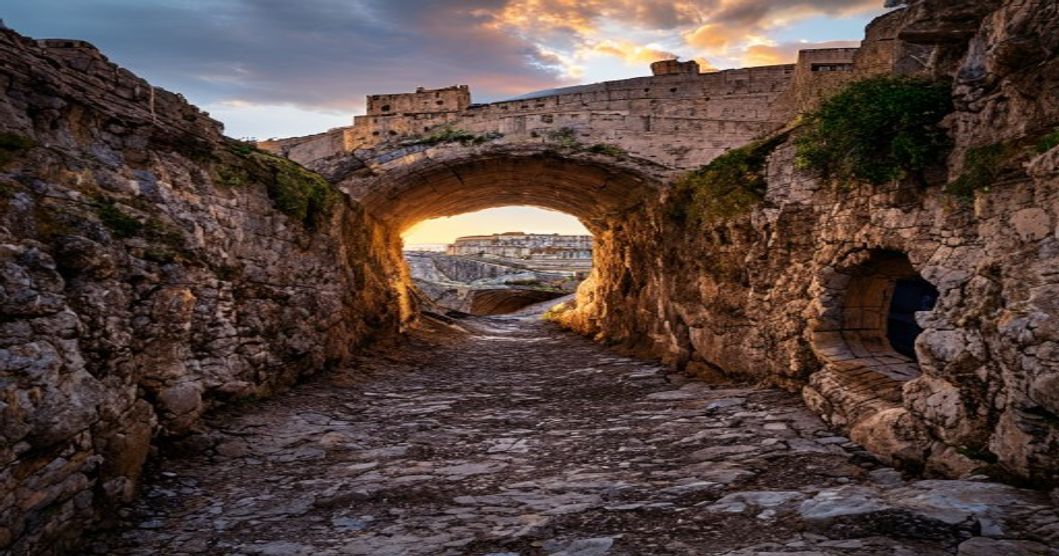
Gibraltar's Great Siege Tunnels were begun on 25 May 1782 under Sergeant Major Henry Ince and cover roughly 300 metres of hand-carved gun galleries. The WWII tunnels, built 1939 to 1945, run approximately 55 kilometres and once housed 16,000 troops. Both systems sit inside the Upper Rock Nature Reserve and are open year-round.
Gibraltar has more underground history than almost any other territory its size. The Rock is hollow in places, with tunnels built across several centuries of military engineering. Two of the most significant tunnel systems, the Great Siege Tunnels from the 1780s and the WWII tunnels from the 1940s, are open to visitors and genuinely worth the time. This is the practical visitor guide for 2026.
Quick Summary
- The Great Siege Tunnels date to 1779 to 1783 and were carved by hand from solid limestone, with work starting on 25 May 1782 under Sergeant Major Henry Ince
- The WWII tunnels were built between 1939 and 1945 and run for approximately 55 kilometres (34 miles), housing up to 16,000 troops
- Both tunnel systems are inside the Upper Rock Nature Reserve, which charges an entry fee
- Guided tours add considerably more context than self-guided, but both options are available
- The tunnels stay cool year-round, making them a genuine break from summer heat on the Rock
- The Gibraltar Cable Car is closed for reconstruction until approximately 2027: access to the Upper Rock in 2026 is by taxi, official Rock Tour operator, or on foot
The Great Siege Tunnels: Gibraltar's 18th Century Underground
The Great Siege of Gibraltar lasted from 1779 to 1783, when combined Spanish and French forces attempted to retake the Rock from the British. During this siege, British and Hanoverian soldiers tunnelled into the northern face of the Rock to position artillery at angles that were otherwise impossible to cover from the surface.
The result was a network of tunnels, gun emplacements, and galleries that stands as one of the engineering achievements of 18th-century military history. Visitors today can walk through the main galleries, see the original cannon emplacements, and stand at the openings where guns once covered the isthmus connecting Gibraltar to Spain.
Tunnelling began on 25 May 1782 after Sergeant Major Henry Ince proposed blasting a passage through the Rock to reach a vantage point that surface artillery could not cover. The idea was approved and what started as a single tactical tunnel became a substantial underground network over the course of the siege. Ince was rewarded with land and a house for his contribution.
The original network covers roughly 300 metres and includes the Windsor Gallery, King's and Queen's Lines, St George's Hall, and Cornwallis Chamber. These are not large spaces by modern engineering standards but the context makes them remarkable: carved by hand and black powder while the Rock was actively under siege. The ventilation holes cut to clear gunpowder smoke and the views through the gun ports over the isthmus are the standout features.
The World War II Tunnels: A City Under the Rock
When World War II began, Gibraltar's strategic importance was immediately clear. The Rock controlled the entrance to the Mediterranean and could not be allowed to fall. Between 1939 and 1945, the British military transformed the existing tunnel network into something on an entirely different scale.
Approximately 55 kilometres of tunnels were excavated, enough to house 16,000 troops as a self-sufficient underground city. The complex included barracks, hospitals with full surgical facilities, a power station, water reservoirs, a bakery, telephone exchanges, and command centres, all buried inside a 426-metre limestone Rock.
| Feature | Details |
|---|---|
| Total tunnel length | Approximately 55 kilometres (34 miles) |
| Construction period | 1939 to 1945 |
| Troops housed | Up to 16,000 military personnel |
| Hospital facilities | Fully equipped surgical facilities underground |
| Water storage | Large reservoirs cut into the Rock |
| Command function | Eisenhower's HQ for Operation Torch planning, November 1942 |
General Eisenhower used Gibraltar's tunnels as headquarters when planning Operation Torch, the Allied landings in North Africa in November 1942. This is not a minor footnote: decisions made underground in Gibraltar helped shape the course of the war in North Africa and the subsequent campaigns in Italy and southern Europe.
Visiting Both Systems: Practical Information
Both tunnel systems are accessed through the Upper Rock Nature Reserve, with the tunnels included in the standard reserve entry. Public listings indicate the adult entry fee sits in the £18 to £21 range depending on the package chosen. Check with the Gibraltar Tourist Board for the current rate before visiting, as pricing is updated periodically.
Getting to the Upper Rock in 2026 requires some planning. The Gibraltar Cable Car has been closed for a full reconstruction since November 2025 and is not expected to reopen until approximately 2027. The alternatives are a licensed taxi tour, one of Gibraltar's official Rock Tour operators, or walking on foot via the Mediterranean Steps from Jews' Gate or the paths from the town centre. The walking routes are steep but manageable for most visitors in good weather.
Both tunnel systems maintain a consistent temperature of around 18 to 20 degrees Celsius year-round. In summer this is a genuine relief from the heat outside on the Rock. Bring a light layer if you are sensitive to cool air, particularly if you plan to spend time in the deeper sections of the WWII complex.
Most visitors combine the tunnels with a full Upper Rock day. St Michael's Cave, a natural auditorium that has served as a concert venue since the 1950s at roughly 300 metres above sea level, is a short walk from the tunnel entrances. The Apes' Den near Queen's Gate, the Skywalk glass platform at 340 metres, and O'Hara's Battery at 420 metres are all within the same reserve. A full Upper Rock visit typically takes 3 to 5 hours.
Guided Tours vs Self-Guided
Self-guided entry with information boards is the standard experience for both systems. Guided tours are available and add considerably more context, particularly for the WWII tunnels where the scale of the engineering and the operational history need explanation to fully appreciate what you are looking at.
Gibraltar has licensed tourist guides who run Upper Rock tours including both tunnel systems. These can be booked through hotels or the Gibraltar Tourist Board. Public listings suggest full Upper Rock guided tours typically run around £30 to £50 per person including entry fees, though rates vary by operator and group size.
The Bottom Line
The tunnels are one of the genuinely best things to do in Gibraltar, and consistently underrated next to the Barbary macaques and summit views that dominate tourist content. The Great Siege Tunnels are a remarkable piece of 18th-century military engineering, hand-carved under fire starting on 25 May 1782. The WWII tunnels are something else entirely: 55 kilometres of underground infrastructure built in wartime, used by Eisenhower to plan operations that shaped the outcome of the war in Europe. Both deserve more than a quick walk-through.
Frequently Asked Questions
Are the Great Siege Tunnels and WWII tunnels the same thing?
No. They are separate systems built centuries apart. The Great Siege Tunnels were begun on 25 May 1782 during the siege by Spain and France and cover roughly 300 metres. The WWII tunnels were built from 1939 to 1945 and are far more extensive, running approximately 55 kilometres with space for 16,000 troops.
How long does it take to visit the tunnels in Gibraltar?
Allow 45 to 90 minutes for the Great Siege Tunnels with self-guided exploration. The WWII tunnel section open to visitors takes 30 to 60 minutes. Most people combine both as part of a full Upper Rock day visit of 3 to 5 hours, taking in St Michael's Cave, the Apes' Den, and the Skywalk as well.
How much does it cost to visit Gibraltar's tunnels?
The tunnels are included in the Upper Rock Nature Reserve entry fee. Public listings indicate adult entry is in the £18 to £21 range depending on the package. Guided tours cost extra, with public listings suggesting around £30 to £50 per person all-in. Check with the Gibraltar Tourist Board for current rates before you visit.
Did Eisenhower really use Gibraltar's tunnels as headquarters?
Yes. General Eisenhower established his command headquarters in Gibraltar's underground tunnels while planning Operation Torch, the Allied landings in North Africa in November 1942. The tunnel complex provided secure, bombproof command and communications facilities deep inside the Rock.
Are the tunnels accessible for people with mobility issues?
Partially. The tunnel floors are uneven in places and getting to the Upper Rock involves steep gradients regardless of route. With the Gibraltar Cable Car closed for reconstruction until approximately 2027, access is by taxi, Rock Tour operator, or on foot, all of which involve some walking. Contact Gibraltar Tourism for current accessibility details before visiting.
Is the Gibraltar Cable Car running in 2026?
No. The Gibraltar Cable Car closed in November 2025 for a full reconstruction and is not expected to reopen until approximately 2027. To reach the Upper Rock in 2026, options include a licensed taxi tour, an official Rock Tour operator, or walking routes such as the Mediterranean Steps from Jews' Gate.